What you will hear
Flamenco guitar basics
How the flamenco guitar works for a first-time listener: toque, the instrument, its techniques, falsetas and compás, and what to hear in a one-hour show.
Book the Casa de la Guitarra show ↗Quick answer
Toque is the flamenco word for the guitar's art, and tocaor is the player. The instrument is made lighter than a classical guitar and often wears a tap plate for percussive golpes. The guitarist introduces the key, the rhythm cycle called compás and the tempo, plays falsetas between verses, and gives the dancer something to answer with the feet. In a one-hour show such as the one at La Casa de la Guitarra, the guitar is the thread through every piece.
What toque means
Flamenco has three arts: cante, the voice; baile, the dance; and toque, the guitar. UNESCO's flamenco record says toque has grown well beyond simply accompanying, and that castanets, hand-clapping and foot-stamping also belong to the art. A guitarist is a tocaor. In a small room you hear the playing at close range: the fingers, the taps on the wood, and the pauses a player leaves for the singer to fill. The rest of this guide names those sounds so that you can pick them out, one by one, without any training in music or Spanish.
The instrument
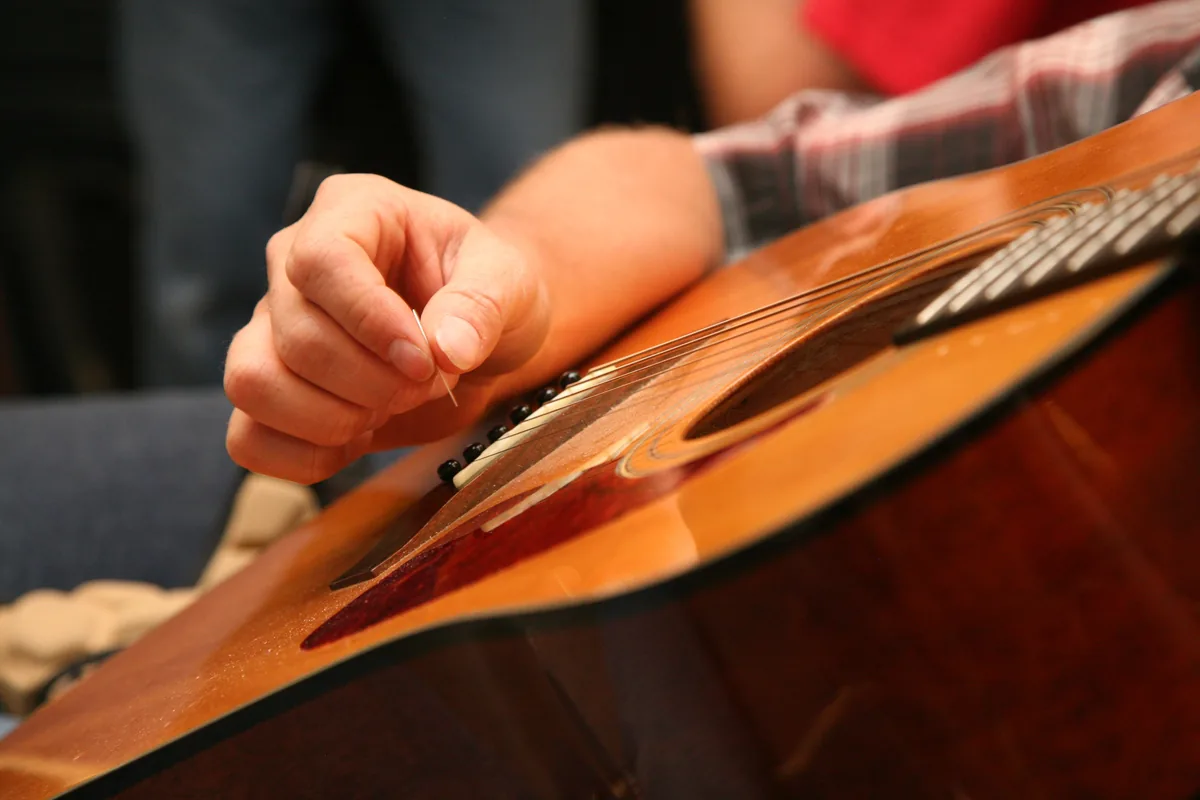
Wikipedia says flamenco guitars are built lighter than classical guitars, with thinner tops, less internal bracing and generally smaller bodies. It lists cypress, sycamore maple and rosewood as the traditional woods for the body, topped with spruce. Spanish Wikipedia describes the typical model as cypress with a cedar neck and a spruce top. The strings are nylon, as on a classical guitar, but the sound is livelier and grittier. Cypress is the wood most tied to the bright flamenco sound, Spanish Wikipedia says, while palo santo was used in the past and is now rare. Many guitars carry a golpeador, a tap plate that protects the wood from finger taps. The strings usually sit lower, and a little buzz is tolerated.
How a tocaor sits and plays
Spanish Wikipedia contrasts the two traditions. A classical player tilts the guitar over the left leg; a flamenco player crosses the legs, rests the guitar on the higher one and holds the neck almost horizontal. The thumb rests on the top, the index and middle fingers play over the upper string, and the middle finger rests on the golpeador for precision. Spanish Wikipedia adds that metal tuning pegs are mostly used today, because wooden ones cause tuning trouble. English Wikipedia adds that the guitar's lighter, narrower build keeps it from overshadowing the singer. From your seat, watch the right hand; it explains most of what you hear.
Five sounds to listen for
These techniques come from Wikipedia's article on the flamenco guitar. Each one becomes easy to hear once you know its name, and an hour gives you time to catch several of them, although no night can promise a particular one. Try to put a name to each as it passes, and do not worry if you miss some; the whole hour is a rehearsal for your ear:
- Rasgueado: strumming with outward flicks of three to five right-hand fingers.
- Picado: single-note scale runs, usually alternating the index and middle fingers.
- Alzapúa: a thumb technique, played up and down, with roots in plectrum playing on the oud.
- Tremolo: a four-note right-hand pattern, where classical tremolo uses three.
- Golpe: a percussive tap on the soundboard.
Falsetas and compás
According to Wikipedia, the guitarist introduces the key, the compás and the tempo of a song, and plays falsetas, melodic interludes, between the verses. Compás is the repeating rhythm of a palo. Wikipedia says no other Western style asks for such precise interpretation, and that when no guitarist is present, palmas (hand-clapping) or knocks on a table can carry it. In the room, listen for the moment the guitar stops outlining the rhythm and starts a melody of its own while the singing pauses. That is a falseta.
Read next: Flamenco glossary
Playing for the singer
A cejilla, or capo, is commonly used to set the key to the singer's range, which lets the player keep the same chord shapes. Spanish Wikipedia describes the guitarist accompanying the sung verse and slipping a falseta in between chords. Some songs are sung unaccompanied, a palo seco. Spanish Wikipedia names two ways of accompanying a verse, por arriba, with the fingering of E major, and por medio, with that of A major. Siguiriyas is the hard test: Wikipedia calls it one of the most difficult styles to accompany and interpret, because of the nuances of the singing, and says guitar, palmas or footwork often add counter-rhythms on top of its twelve counts.
Playing for the dancer
Wikipedia says volume was historically important so that guitarists could be heard over dancers' shoes. A danced alegrías passes through six sections, according to its article: salida, paseo, silencio, castellana, zapateado and bulerías, the last of them a lively closer. The guitar supplies the ground for each one. Wikipedia gives the usual tempo of alegrías as 120 to 170 beats a minute, with livelier speeds suiting the dance and quieter ones suiting a singer alone. If the dancer comes on in the middle of your hour, as travellers who have been describe, listen to how the guitar changes from an introduction into a rhythm that answers the feet.
From accompaniment to the concert stage
Wikipedia credits Ramón Montoya, born in Madrid in 1879, as one of the first to challenge the guitar's supporting role and appear as a soloist. It names Montoya, Sabicas, Paco Peña and Paco de Lucía among the players who helped present flamenco guitar as a solo instrument. Paco de Lucía, from Algeciras, widened flamenco's influences to include Brazilian, Arabic and jazz music, and his 1991 recording of Rodrigo's Concierto de Aranjuez is noted as a landmark. Seville's own part in the story has its guide.
Read next: Seville's guitar story
A listening plan for the hour
You do not need to count twelve beats to enjoy flamenco. A handful of simple things to listen for are enough, and the one-hour length leaves time for each of them. Use the list as a loose checklist rather than a test, and let the music take over whenever it wants to. Nobody in the room is marking your answers, and the best listening usually happens when you stop trying to tick things off.
- Before the first song, notice whether the guitarist fits a cejilla.
- When the singing starts, follow the guitar's rhythm underneath it.
- When the voice stops, listen for a falseta.
- When the dancer comes on, hear how the guitar answers the feet.
- Near the end, notice whether the pace lifts: bulerías often closes a gathering.
Reading the guitars on display
The house displays flamenco guitars dating back to the 19th century, according to Flamenco Sevilla's page, and the ticket includes access to them. Use what you have just read as a short list of things to look for: a tap plate, a lighter build, the colour of the wood. Compare any guitar in the cases with the instrument on stage. Wikipedia says Antonio de Torres did not distinguish between flamenco and classical guitars, so differences between the older instruments can be subtle.
Who this isn't for
Think of this page as a primer, not a lesson, and the show is not a guitar class. If you want to learn to play, you need a teacher; the dance class on the booking page covers dance only. Anyone who wants a loud, dance-led production will find that a small room built around guitars does things differently. And if you prefer not to read before a show, skip the guide altogether: the music works without it, and the hour will make sense on its own.
Frequently asked questions
What is toque?
The art of flamenco guitar playing. UNESCO says it has grown well beyond simply accompanying.
What is a falseta?
A melodic interlude played by the guitar between sung verses.
How is a flamenco guitar different from a classical one?
It is built lighter, with thinner tops and less bracing, and often carries a tap plate for golpes.
What is compás?
The repeating rhythm a palo is built on. With no guitar, palmas or knocks on a table can keep it.
Do I need to know any of this?
No. The hour makes sense on its own; this guide only names what you will hear.
Will the guitarist play a particular piece?
The artists decide the programme and may alter it nightly, so nothing specific can be promised.
Sources
- The flamenco guitar, per Wikipedia
- Spanish Wikipedia entry on the flamenco guitar
- Wikipedia entry on the art of flamenco
- UNESCO's intangible heritage record, flamenco entry, 2010
- Wikipedia entry on the palo alegrías
- Wikipedia entry on the palo siguiriyas
- Flamenco Sevilla's profile of the house
- Wikipedia entry for the guitarist Ramón Montoya